

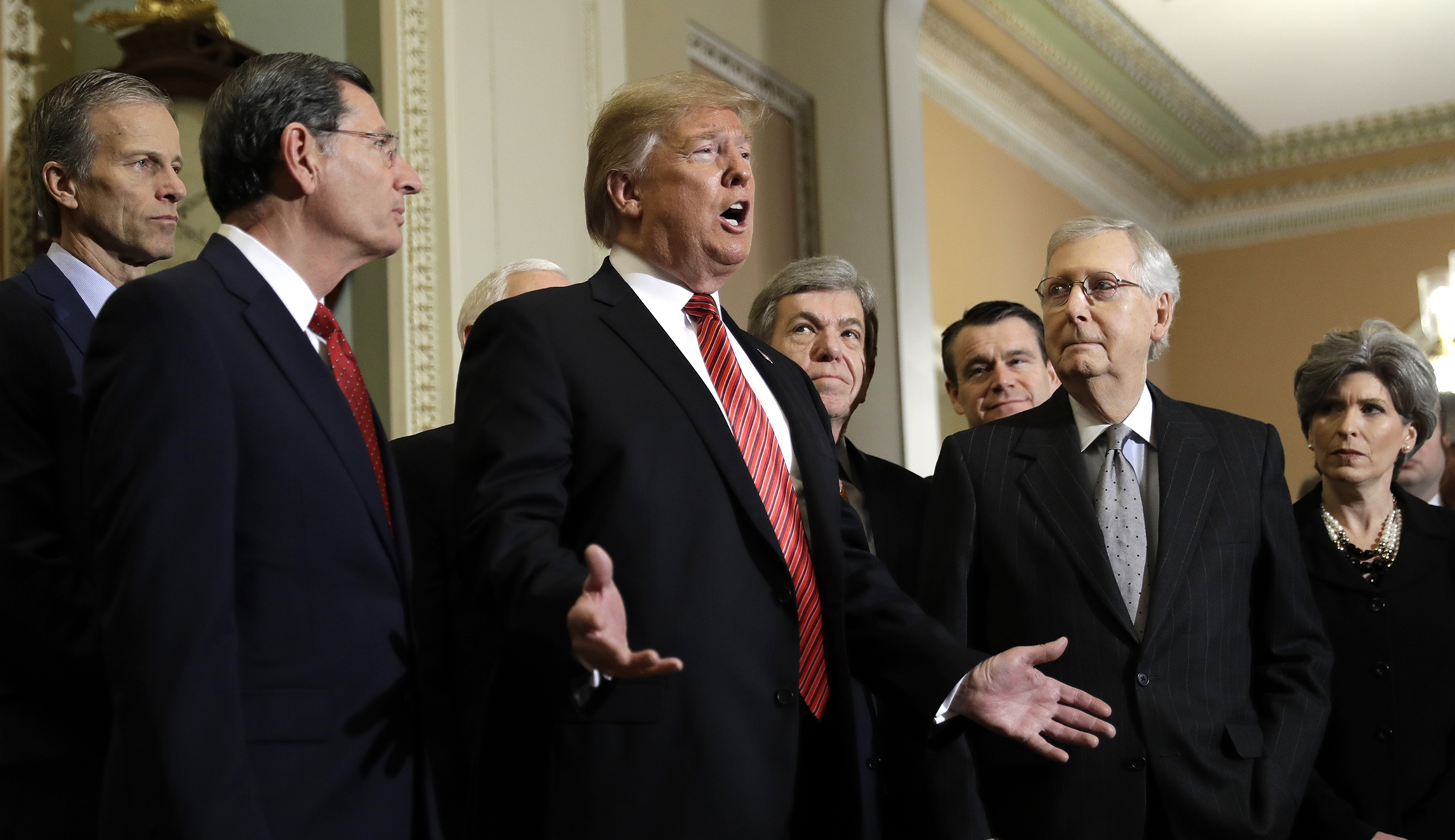
President Trump and lawmakers will face a new level of pressure to end their stalemate over border wall funding Friday when hundreds of thousands of federal workers miss their first paycheck as a result of the partially shuttered federal government, strategists say.
“Tomorrow is the first day when many people will feel the direct impacts of the shutdown,” veteran Republican strategist Alex Conant said Thursday. “I think to the extent that there’s a slowdown in economic activity because of the shutdown, that will put tremendous pressure on the president and many members of Congress, Republican and Democrat.”
Recommended Stories


In the halls of Congress, though, even some of the president’s closest allies are recognizing that they about to enter a new foray in the battle over the wall.
“I think it’s going to get exponentially harder for both parties beginning tomorrow,” Sen. Lindsey Graham, R-S.C., said.
Parts of the government have remained closed since Dec. 22, when funding for a slew of federal agencies lapsed.
The shutdown, which affects roughly 800,000 federal workers, is the result of an impasse between the White House and Democrats over funding for a wall along the southern border, for which Trump has demanded $5.7 billion.
Democrats have rebuffed that request, and negotiations have broken down.
In the weeks since the shutdown began, parts of national parks have closed, Smithsonian museums and galleries have shut their doors, and federal employees have been working without pay.
But on Friday, when the shutdown becomes the longest in history, strategists say its effects will be felt in households nationwide.
“Every congressional district in the country will have federal workers who aren’t receiving paychecks tomorrow,” Conant said. “That will make more fodder for local TV stories and peer-to-peer communications. I think people will start seeing on their Facebook feeds that their friend didn’t get paid and, as a result, can’t go to the movies this weekend or pay some bills.
So far, neither Democrats nor Trump have indicated they’ll budge when it comes to wall funding, though Trump has signaled at times he’s willing to accept less than $5 billion. The president this week threatened to declare a national emergency if a deal can’t be reached, a move that would enable him to invoke his emergency powers and redirect funding to build the wall without authorization from Congress.
Brad Bannon, a Democratic strategist, said the growing effects of the shutdown are like “death by a thousand cuts” for House Republicans and bolster Democrats’ messaging on the costs of the shutdown.
“It gives the Democrats more ammunition,” he said. “And they’ve already got some ammunition. If the federal courts or something else closes down at some point, that’s just another bullet in the gun.”
Republicans have largely remained united behind the president, though some cracks have begun to show among Senate Republicans who are concerned about the long-term effects of the shutdown.
Conant said a growing chorus of criticism from Republicans could hurt Trump politically, but contended that Republicans will likely remain unified.
“We’re quite a way away from the dam breaking among congressional Republicans for a variety of reasons, not the least of which is most of them are more worried about the primary than the general election,” he said. “They all recognize that with 2020 being a presidential year, breaking with Trump could be a suicide pact at this point.”
Ford O’Connell, a longtime Republican strategist, noted that both sides are feeling the heat, but said it “behooves” Trump to continue to shine a spotlight on the need border security.
“It’s one of these things where everyone is going to have skin in this game the second the first paycheck is missed, and then it’s going to become a battle of wills,” he said.
O’Connell said he expects Trump will hold firm in his demand for wall funding and predicted the shutdown could last until Trump delivers his State of the Union address Jan. 29.
Reporter Al Weaver contributed to this article.
