

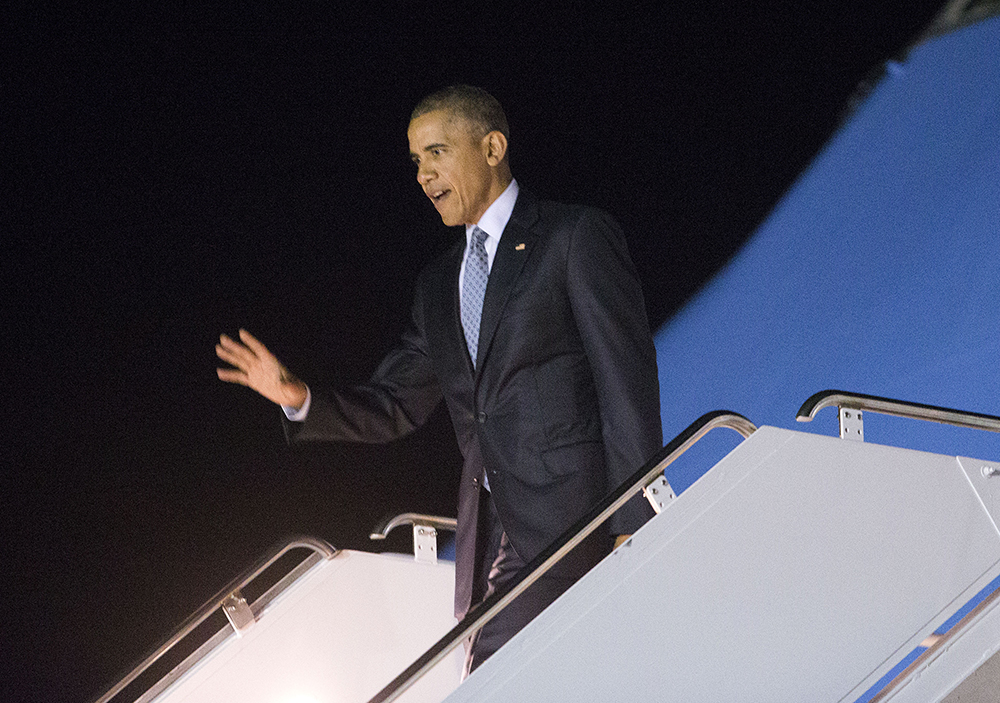
Small businesses have a new potential tax hike to worry about, thanks to President Obama’s budget.
Recommended Stories


The fiscal 2017 budget proposal, Obama’s last, includes a long list of ambitious proposals that do not have a chance to advance in Congress. But by labeling a provision of the tax code affecting small businesses a “loophole,” the administration may have set a precedent for future presidents to close it.
“It’s a big deal for us,” said Nick Karellas, tax counsel for the National Federation of Independent Businesses, a group that represents hundreds of thousands of small businesses. “Whoever is in the White House next has this on their blueprint list.”
The Obama administration’s proposal has two parts, both connected to legal entities commonly used by small businesses.
The first would be eliminating a “loophole” that allows some taxpayers to avoid the 3.8 percent Obamacare net investment tax by defining themselves as businesses.
When Obamacare was written, it included a carve-out from the investment tax for small employee-owned businesses that file taxes through the individual side of the tax code, or “pass-throughs,” as they’re known. The administration had in mind to prevent small businesses such as auto dealerships from facing taxes.
Now, however, the administration is concerned that some individuals who are investors in companies organized as pass-throughs are essentially defining themselves as employees in those businesses to have their investment income, which would be subject to the 3.8 percent tax, reclassified as earnings to avoid it. The White House wants to make sure that the tax applies to all appropriate income.
The second part would be closing what has been known as the Gingrich-Edwards loophole, because both former House Speaker Newt Gingrich and former North Carolina Democratic Sen. John Edwards benefited from it.
The loophole involves owner-employees of pass-through businesses avoiding the equivalent of payroll taxes for self-employed people by classifying more of their income as an ownership stake, which is not subject to payroll taxes, than as labor compensation, which is.
Both loophole-closings would apply only to businesses or individuals earning more than $200,000 annually, or $250,000 for couples.
Together, they would be a major revenue-raiser: By the White House’s estimate they would boost taxes by $270 billion over 10 years.
The White House suggested that the changes would mostly prevent major investment firms or hedge funds, not the small businesses contemplated by the original law, from reclassifying themselves to reap tax savings.
The extent to which that is already happening isn’t clear, and some of the investment firm associations contacted by the Washington Examiner were still determining whether they would be affected.
Scott Greenberg, an analyst at the right-of-center Tax Foundation, said that while evidence of such income reclassification might be anecdotal, it would be expected that over time businesses would try to take advantage.
“It’s a fairly consistent principle of tax planning that if you tax one form of income higher than another form of income … businesses will employ resources in order to legally justify shifting their money,” Greenberg said.
What is clear is that some small businesses would see their taxes increase.
The provision “definitely has the potential to impact our members directly,” said Karellas, noting that three-quarters of NFIB members are pass-throughs, the kind of entities that could be affected.
The S-Corporation Association, a trade group for pass-throughs, described the proposal as “a new tax hike directly targeted at the Main Street employer next door,” noting that it would raise the top rate on pass-through income to 44.6 percent.
That’s cause for small businesses to be wary of the next time a future president or Congress is looking for ways to raise revenue.
It “happens fairly often, that the administration’s budget proposal will identify ‘loopholes’ that later enter the public conscience because of the policy conversations begun by the president’s budget, and sometimes get changed into law,” Greenberg said.
