
With early voting for the midterm elections well underway, the new Postal Service mail-in ballot requirements are not being implemented this year.
President Donald Trump’s wishes to restrict mail-in voting in the name of election integrity were struck down by the Supreme Court last month. The ruling prohibits the Trump administration from enforcing the USPS rule for the November elections, but the underlying legal questions are not yet resolved.
Recommended Stories
Earlier this year, Trump signed an executive order setting up a system to verify the citizenship of voters taking part in mail-in voting for future federal elections. The USPS followed suit with a final rule in August establishing stringent standards for voting by mail. The rule was blocked by a federal judge, whose decision was backed by the Supreme Court. However, the administration could still impose such a rule in the future.
So, where does mail-in voting stand now?
What did the administration want USPS to do?
The administration directed the USPS to deliver mail-in ballots only to vetted U.S. citizens permitted to vote in the midterm elections.
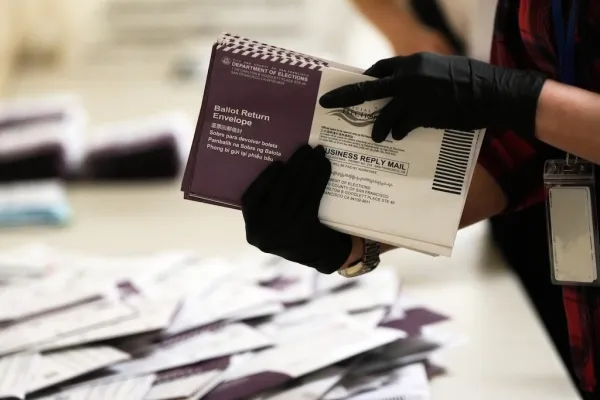
The rule would have required mail-in ballots to be stamped with USPS markings and sent inside automation-compatible envelopes with unique barcodes. To verify the voters’ citizenship status, state election officials would have submitted voters’ names, addresses, and corresponding barcode information through a portal operated by the federal government. The policy was intended to help the USPS track mail-in ballots more effectively and to ensure ballots are sent only to eligible voters.
State officials expressed concerns that the portal’s current design may result in the rejection of an entire batch of ballots if only one is scanned improperly.
“As presently designed, if even one bar code on one single ballot in a bulk-mailing of 10,000 ballots fails to properly scan during the verification process, the entire batch is rejected and sent back to the state — effectively stopping the ballots from being mailed to voters,” an anonymous whistleblower complaint reads. “Even under ordinary circumstances this would be problematic because of predictable errors in any barcode scanning process.”
Mail-in voting remains available to all eligible voters in their states, and the federal mailing agency is expected to deliver mail-in ballots for the general election without any changes. A few states have already begun sending absentee ballots ahead of Nov. 3.
What have the courts said?
An Obama-nominated federal judge in Massachusetts blocked the new mail-in ballot requirements from taking effect. U.S. District Judge Indira Talwani first issued a 14-day temporary restraining order in August and later replaced the ruling with a preliminary injunction.
Talwani concluded that the plaintiffs challenging the rule were likely to succeed on the merits because the Constitution says that states have authority over federal elections, with Congress alone having the ultimate power to override them. As part of the executive branch, the USPS does not have the authority to regulate how states handle their federal elections, according to Talwani.
She also found that implementing the rule right before the midterm elections could cause significant disruptions to the mail-in voting process, as many states have already printed ballots and envelopes.
The DOJ quickly appealed the judge’s latest decision to the Supreme Court, arguing the rule should proceed without any further delay. The effort was unsuccessful.
How did the Supreme Court rule?
On Sept. 14, the Supreme Court denied the administration’s emergency request to implement the mail-in ballot restrictions this fall.
In a brief order, the justices determined that the government was unlikely to succeed on the merits of its challenge.
The administration asked the Supreme Court to grant a stay that would override Talwani’s preliminary injunction as the postal service waited for the U.S. Court of Appeals for the 1st Circuit to rule on the Trump administration’s appeal. That way, the rule could be in effect for the 2026 elections through Nov. 3.
Justices Samuel Alito and Clarence Thomas dissented from the order, while Justice Brett Kavanaugh concurred but indicated he would side with the administration later.
It may be some time before the justices decide on the constitutionality of the executive order underpinning the ballot rule. Such a ruling may come after the general election, following a thorough review of the case with oral arguments.
The high court previously sided with the Trump administration, allowing the USPS ballot rule to proceed without ruling on its legality. The majority of justices determined that it was too early for courts to consider the challenge because the executive order had not yet been carried out.
Three lawsuits were playing out over the issue. One was filed by a group of states led by California, another was brought by the League of Women Voters of Massachusetts, and the last was spearheaded by the Democratic Senatorial Campaign Committee.
What did a USPS whistleblower say?
An anonymous whistleblower who worked at the federal agency recently alleged that the USPS rushed to implement a technical ballot-verification system, drawing the attention of congressional Democrats.
The whistleblower disclosure, sent to Sen. Richard Blumenthal (D-CT), warned that the midterm elections could be derailed because of the federal plan to process mail ballots.
The USPS whistleblower also claimed that the agency violated Talwani’s June 25 injunction by continuing to work on the federal portal while the rule’s implementation was paused.
“USPS should have ceased all work on the Portal on June 25, 2026, with the earliest conceivable date to resume being August 26, 2026,” when a prior court order was lifted, Blumenthal wrote in a letter to Postmaster General David Steiner. “The whistleblower allegations demonstrate that was not the case, with USPS directing work to continue on the Portal after the first court order to cease work and prior to the recent court decisions allowing USPS to proceed.”
The whistleblower argued that the system’s “sloppy” and rushed implementation “poses significant risk” to the efficiency of the midterm elections.
“Potentially millions of American voters may not receive their mail-in ballot this election cycle in a timely manner, or at all,” the document reads. “The Whistleblower’s assessment and recitation of the facts around the risky and haphazard development of the project is a compelling warning of catastrophic failure which could derail the midterm elections.”
How are Democrats pushing back?
The Democratic Party is fighting Trump’s alleged election interference with a new three-point plan that the party says will protect the vote and help it win elections up and down the ballot.
The nationwide initiative, called the “New Battlefield Project,” has a component to help boost early voting across the nation’s 57 states and territories.
“The first-ever national early vote campaign — a sustained ‘bank your vote’ push to turn Democratic voters out early, by mail and in person, through digital tools, toolkits, and targeted advertising focused on the communities most vulnerable to GOP interference, so ballots are banked before Election Day — making it more likely Democrats win, and harder for Trump and his allies to cheat,” a document obtained by the Washington Examiner reads.
The Association of State Democratic Committees, an official arm of the Democratic National Committee, is leading the push in the final weeks ahead of the midterm elections.
VOTER REGISTRATION AND EARLY VOTING: KEY DATES AND DEADLINES IN THE 2026 ELECTIONS
The Democrat-led initiative also sets up a “democracy defense network” designed to identify and counter “illicit tactics” that could sway elections. Separately, the initiative establishes a program that trains “tens of thousands of volunteers” to help monitor the polls. Party officials have expressed concerns about the administration deploying Immigration and Customs Enforcement officers to polling sites.
Last month, White House border czar Tom Homan confirmed the administration has no plan to detain illegal immigrants at the polls this fall.