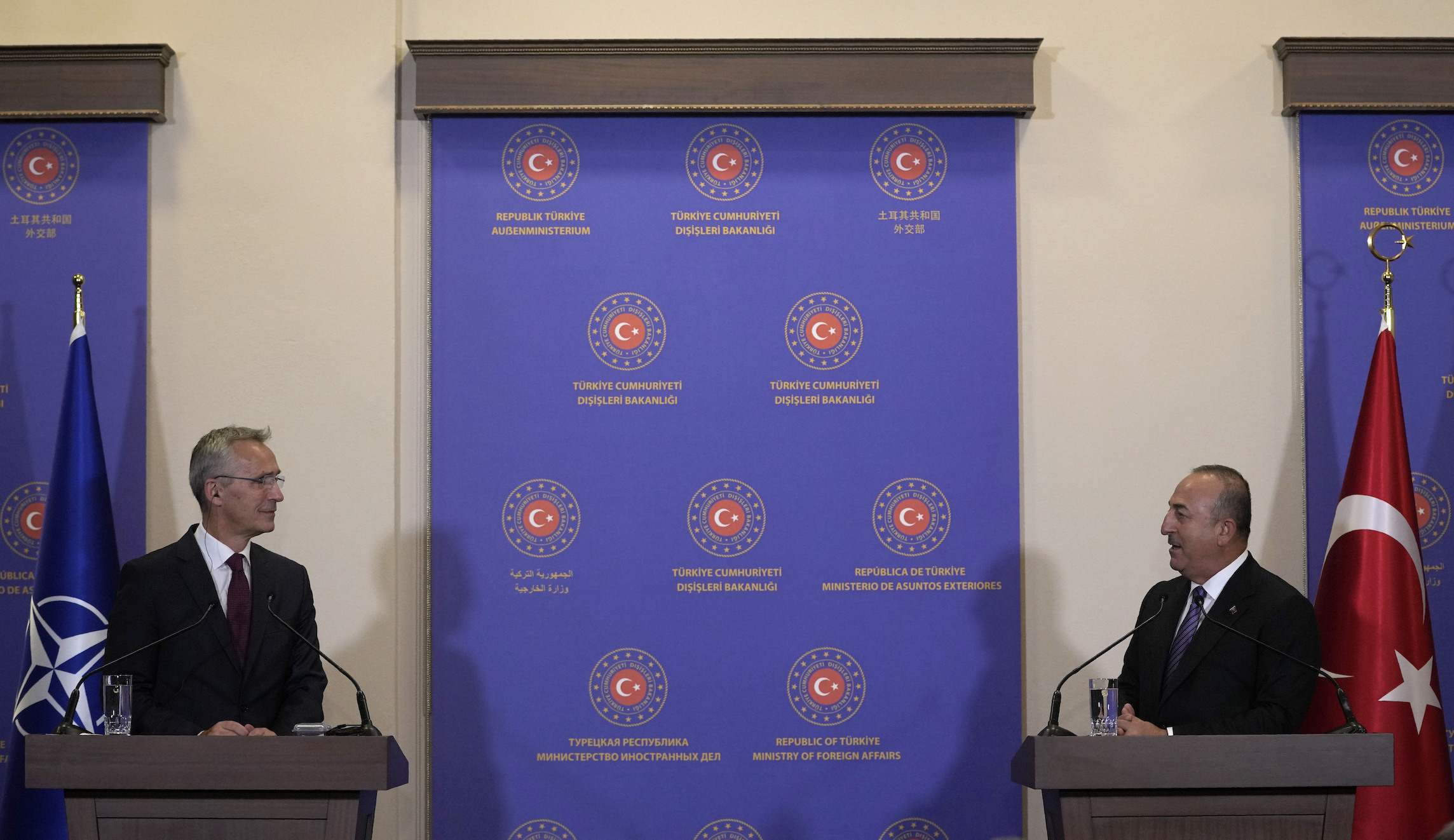
Turkey’s continued postponement of Finland and Sweden’s joint admission into NATO raises the risk of a clash with Russia, the trans-Atlantic alliance’s top official warned.
“So it is time to welcome Finland and Sweden as full members of NATO,” NATO Secretary-General Jens Stoltenberg said Thursday. “Their accession will make our alliance stronger and our people safer. In these dangerous times, it is even more important to finalize their accession, to prevent any misunderstanding or miscalculation in Moscow, and to send a clear message to Russia that NATO’s door remains open.”
That appeal fell on deaf ears in Ankara, where Turkish President Recep Tayyip Erdogan has issued a series of preconditions for their admission — the most controversial of which centers on Sweden’s Kurdish diaspora, which Erdogan has denounced as a hotbed of terrorism. That controversy produced a public split with Stoltenberg over the question of whether Sweden and Finland have fulfilled the terms of a memorandum designed to mollify Erdogan.
“We need to see its implementation, and we have an upcoming calendar and a series of meetings to deliberate on this,” Turkish Foreign Minister Mevlut Cavusoglu said during a press conference with Stoltenberg. “We expect the new government of Sweden to take steps, even more concrete steps. We’re happy with the steps they’ve taken already, but we’d like to see their final steps within the scope of the memorandum.”
NATO’S STOLTENBERG: NO CHANGES IN RUSSIAN NUCLEAR POSTURE DESPITE PUTIN RHETORIC
Stoltenberg intervened to dispute Cavusoglu’s assessment. “They are living up to the joint memorandum, and they also see the value in also working closely together with Turkiye to fight terrorism,” the former Norwegian prime minister said, using the Turkish pronunciation of the country’s name that Erdogan prefers. “So, Finland and Sweden have delivered.”
Finland and Sweden hoped to enjoy a fast-tracked NATO application process, but Erdogan threw a spanner into their admission by protesting their refusal to sell weapons to Turkey and accusing the Nordic states of harboring anti-Turkey terrorists. Sweden announced in September that it would lift the embargo, but Cavusoglu emphasized that Turkey wants irreversible guarantees.
“It’s important that once these countries accede, no steps back are taken,” he said. “It’s important that we show the Turkish people that concrete steps have been taken.”
The thornier dispute centers on Sweden’s embrace of Turkish Kurds. Erdogan complains that the Kurdish diaspora in Sweden is replete with links to the PKK, a Kurdish militant group designated as a foreign terrorist organization.
“As long as the terrorist organizations are demonstrating on the streets of Sweden, and as long as the terrorists are inside the Swedish parliament, there is not going to be a positive approach from Turkey towards Sweden,” Erdogan said last month.
That comment was an apparent reference to Swedish lawmaker Amineh Kakabaveh, an Iranian Kurd by heritage who was a member of a Kurdish militia as a teenager during the Iran-Iraq War and eventually was elected to the Swedish parliament after fleeing to Europe. More broadly, Turkey wants the extradition of dozens of Kurds in Sweden.
“Sweden is committed to address … pending extradition requests of terror suspects expeditiously and thoroughly,” Swedish officials wrote in an October letter obtained by Reuters.
Erdogan has drawn a distinction between Sweden and Finland, saying that “Finland is not a country where terrorists are roaming freely.” Finnish and Swedish officials want to join NATO simultaneously — a joint maneuver that reflects the traditional unity of their strategic cultures.
CLICK HERE TO READ MORE FROM THE WASHINGTON EXAMINER
“The timeline, the calendar, is up to the two countries and the steps that they will take,” Cavusoglu said. “Relatively speaking, we don’t have that much of a problem with Finland’s stance. … We know that these two countries want to join together. … We would like to see it, too.”

