

American and Iranian officials are set to meet in the capital of Oman on Friday for discussions about how to prevent what could ultimately end up being a regional war.
Presidential envoy Steve Witkoff and Jared Kushner, the president’s son-in-law, will lead the U.S. side in the negotiations, which nearly fell apart after Iran demanded changing the location of the talks from Turkey to Oman.
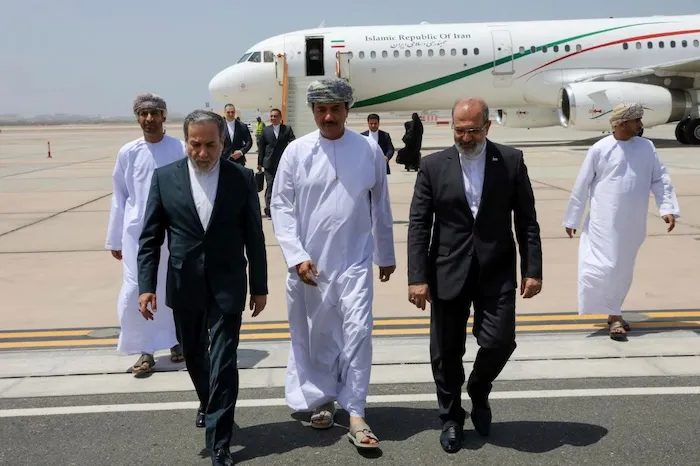
Iran’s foreign minister Abbas Araghchi said the talks “are scheduled to be held in Muscat on about 10 a.m. Friday,” and he added, “I’m grateful to our Omani brothers for making all necessary arrangements.”
What are they negotiating over?
The Trump administration wants Iran to agree to stipulations about their nuclear program, their ballistic missile stockpiles, and support for their proxy forces in the region. Iranian leaders, however, have said they’re willing to negotiate on their nuclear program but not on the other subjects.
This difference alone could prevent a deal from being accomplished or from being meaningful.
“I think in order for talks to actually lead to something meaningful, they will have to include certain things and that includes the range of their ballistic missiles,” Secretary of State Marco Rubio said on Wednesday. “That includes their sponsorship of terrorist organizations across the region. That includes the nuclear program, and that includes the treatment of their own people.”
Iran has been accused of trying to replenish their ballistic missile arsenal in the aftermath of last June’s 12-day war with Israel. Iran fired countless ballistic missiles and drones at Israel during the conflict, some of which evaded Israeli defenses, killing dozens and injuring hundreds of people, according to the Israeli government.
The U.S. military, which aided Israel in intercepting the incoming missiles, also carried out the bombings of three of Iran’s nuclear facilities during the war. U.S. B-2 aircraft flew from Missouri’s Whiteman Air Base to Iran, carried out the operation, and then flew back stateside as part of what was called Operation Midnight Hammer.
American officials insisted they “totally obliterated” those facilities, though Pentagon officials later acknowledged setting back their nuclear program 1 to 2 years.
Iran spent decades aiding proxy forces in the region with the intent of creating plausible deniability for Tehran as those groups more directly confronted their joint enemies in Israel and the United States. Those groups include Hamas in Gaza, Hezbollah in Lebanon, the Houthis in Yemen, and militias in Syria and Iraq, all of which have been badly degraded in recent years by both Israeli and U.S. forces in the aftermath of Hamas’s Oct. 7, 2023, terrorist attack that prompted the subsequent conflicts between Iran and its proxies and Israel.
The proxies largely did not get directly involved during the Israel-Iran 12-day war, though some have warned they would come to Iran’s defense this time around if the U.S. attacks them.
There is also the possibility, experts warn, that Iran could try to drag out negotiations while delaying a possible U.S. mission.
“I could see Iran being willing to engage in negotiations just to buy time, but those demands are not going to be met, particularly not right now, after a huge rebellion, which was only put down by killing maybe 25,000 unarmed citizens, to agree to those demands would be viewed as a sign of weakness by the Iranian regime, and they would, I think, be even less likely to agree than usual,” Elliott Abrams, who served as Trump’s Iran envoy for Iran during his first administration, told the Washington Examiner.
President Donald Trump has threatened a more significant military operation than when the U.S. targeted their nuclear facilities, while Iranian officials have warned that doing so would incur a more significant retaliatory operation from them.
Iranian protesters
Nationwide protests erupted across Iran in December, broadly due to the worsening economy, the latest flare-up in intermittent protests dating back a little less than a decade against the regime. As they have in the past, Iran’s security forces used lethal force to quell the protests, killing thousands of people.
Trump, amid the crackdown, threatened to get involved if Iran killed more protesters, and later said they halted hundreds of scheduled executions, though an Iranian official denied it.
“Help is on the way,” Trump said in early January, and had the military redirect the USS Abraham Lincoln carrier strike group to the region.
The protests have largely died down now, even though the expanded U.S. military presence in the region remains and tensions are still high. The negotiations could be an off-ramp for the president who warned earlier this week that Ayatollah Ali Khamenei, the supreme leader, should be “very worried.”
Military action
It’s unclear what the U.S. objective and targets would be if the president approved a mission.
The U.S. could target the internal security forces that were involved in the crackdown, or hit military targets, such as their ballistic missile production and stockpile facilities, or they could go after the senior leaders of the regime.
If the U.S. does attack, Iran could retaliate by targeting any U.S. base in the region, the carrier strike group off their coast, or Israel directly. There are 30,000 to 40,000 U.S. troops in the region.
Earlier this week, two incidents occurred between U.S. forces in the region and the Iranians that threatened to further escalate the situation.
A U.S. F-35C aircraft from the USS Abraham Lincoln shot down a Shaheed-139 drone flying “aggressively” as it headed toward the carrier strike group with “unclear intent,” U.S. Central Command Spokesman Capt. Tim Hawkins told the Washington Examiner.
Later that day, two Islamic Revolutionary Guard Corps boats and a Mohajer drone approached the U.S.’s M/V Stena Imperative in the Strait of Hormuz “at high speeds and threatened to board and seize the tanker,” he said.
Rubio recently acknowledged that “no one knows” who would take over governing Iran if Khamenei is removed from power.
