

President Donald Trump has made clear there are two very different directions the war in Iran could take in the coming weeks: a negotiated end or an attempt to escalate the war to win it, which comes with risks.
The president announced on Thursday that the United States would extend the negotiating window to prevent a major escalation, which he had already extended. He initially gave Iran 48 hours to reopen the Strait of Hormuz last Saturday, then pushed the deadline back on Monday before it expired by five days; Thursday’s announcement preempted the expiration of Monday’s deadline.
The new Trump-imposed deadline is April 6, but he has a history of pushing his self-imposed deadlines and emphasized that point during Thursday’s Cabinet meeting, saying, “In Trump time, a day, you know what it is, that’s an eternity.”
Escalation
The military has deployed thousands of additional troops to the region, bringing new capabilities and expertise that other forces already fighting in the war don’t have.
Trump could authorize a number of different military options depending on his objectives. He could approve a small operation to try and recover the more than 900 pounds of enriched uranium believed to be buried beneath the rubble of the nuclear facilities U.S. forces destroyed last year. Such a mission would incur risks because it would require digging through rubble deep underground while ensuring those involved are sufficiently defended, and it’s unclear the state of the uranium, given the destruction of the facilities.
Alternatively, the president could approve an operation designed to try to reopen the Strait of Hormuz; the options of how to do so are varied, but all include risks to the troops involved.
One such possibility would be for U.S. forces to try to invade one of the small islands off Iran’s coast in the Persian Gulf, north of the strait. But that also means ensuring those troops have the air support necessary for their safety.
“The ground forces we are deploying have the capability to take one of these small islands — perhaps Kharg,” former U.S. Central Command head Gen. Joseph Votel told the Washington Examiner. “But we would have to be prepared to reinforce and sustain them if they are going to hold it for an extended time. Putting troops on the ground implies that we can get them there and then support, sustain, and protect them. There is risk involved in all of this, and of course, those risks would need to [be] mitigated.”
Even if the president has deployed elements of the Army’s 82nd Airborne Division as a tactic to put more pressure on the regime to capitulate to U.S. demands, that may not be enough to convince hardliners in Iran’s regime to agree to the Trump administration’s terms to end the conflict.
“Another big minus is that when a country, certainly when the United States, introduces ground forces, that tends to create all these dynamics on their own that draw in more ground forces,” Rosemary Kelanic, the director of the Middle East Program at Defense Priorities, told the Washington Examiner. “So those ground forces get attacked, you send reinforcements. The reinforcements get attacked. So then you expand the objectives to try to take out more places where your ground troops are being attacked from and, etc., etc.”
Kelly Grieco, an expert with the Stimson Center, told the Washington Examiner the deployment is an attempt for the U.S. “to gain some leverage” by “signaling a willingness to potentially escalate with” the talks of a possible limited ground operation but she doesn’t think it’s going to be “effective in completing the Iranians to change their negotiating position because this is a war of survival for them, it’s existential.”
Votel, who oversaw the war on terrorism as CENTCOM chief from 2016-19, agreed and warned that Iran could respond to American escalation with further escalation.
“For them this conflict is existential; its about survival. I think they value this over the destruction that is being wrought on their country,” Votel said. “My concern would be that an attempt to escalate to deescalate may result in even greater escalation.”
“There does not seem to be a serious internal threat to the regime at this point. The [Revolutionary Guard] hardliners are proving to be the backbone for the current regime and appear to be ascendant in influence over the theocratic leadership,” he added.
Shipping has largely come to a standstill in the region, sending energy and oil prices skyrocketing across the world. U.S. officials have also discussed the possibility of the Navy escorting ships through the strait, but that puts those troops in harm’s way and still requires the companies operating those ships to be willing to take that risk.
Last week, Israeli forces targeted Iranian facilities linked to the South Pars gas field, which prompted a near instant Iranian retaliation against major energy facilities of its Persian Gulf neighbors and Israel. At the time, Trump distanced the U.S. from the Israeli strike, but said U.S. forces would destroy that facility if Iran carried out similar attacks against energy facilities in the region.
Following Trump’s power plant threat, which experts have argued could amount to war crimes, Iran’s Parliament Speaker Mohammad Bagher Ghalibaf — the individual believed to be the person the U.S. is now negotiating with — threatened to hit energy sites across the Middle East.
“I think we saw this last week when the [Israeli military] struck an Iranian energy target and the Regime quickly responded by going after the natural gas facilities in Qatar – having an immediate and substantial impact. We should really think through all potential Regime responses to an escalation on our part,” Votel added.
There are also concerns about the expenditure of critical U.S. munitions, both offensive and defensive, through a month of the war, which officials had warned about even before the war began. The military has fired more than 850 Tomahawk cruise missiles already, which are fired from Navy surface warships and submarines, according to the Washington Post.
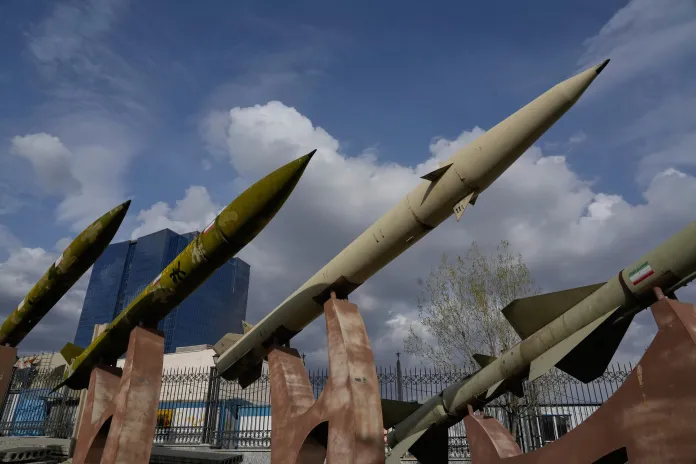
Earlier this week, the Pentagon announced multiple agreements with defense contractors to increase production of the Precision Strike Missile, seekers used for the Terminal High Altitude Air Defense interceptor, and of critical components for the military’s munitions stockpile, including navigation systems.
U.S. forces have “fired thousands of Tomahawks, Precision Strike Missiles, and other long-range offensive weapons into Iran, while also using Patriot, THAAD, and Standard Missile interceptors at an alarming rate to defend against Iran’s retaliatory attacks,” Sen. Jack Reed (D-RI), the top Democrat on the Senate Armed Services Committee, said earlier this week.
“For decades, the Department of Defense has rightly prioritized the development of highly capable, precision-guided munitions. These systems are extraordinarily effective. They are accurate, reliable, and in many cases unmatched. But they are also expensive, complex, and slow to produce. In a protracted conflict, those attributes create real limitations,” he continued.
There have already been other consequences for the U.S. in the war. Thirteen American service members have been killed, while 303 others have been injured, though roughly 90% of the wounded have returned to duty, while 10 others remain seriously wounded, according to CENTCOM spokesman Capt. Tim Hawkins. Several U.S. bases in the region have been hit as well by Iranian drones and missiles.
Negotiation
The Trump administration came up with a 15-point proposal to end the war, which Iranian leaders appeared to reject quickly, even though administration officials, including the president, say they want to make a deal.
The offer included aspects that Iran had already rejected prior to the war, though this snub could result in an American escalation.
A summary of the U.S. proposal includes opening the Strait of Hormuz; limitations of Iran’s ballistic missile capacity and range; stripping the country of its nuclear capabilities and facilities; handing over its enriched uranium to the International Atomic Energy Agency; agreements to total transparency and independent inspections; ceasing support of proxy terrorist groups in the region; and the total decommissioning of the three nuclear facilities the U.S. bombed last year, according to Bloomberg.
Steve Witkoff, part of the U.S. negotiating team, confirmed the plan on Thursday, saying it had been circulated through the Pakistani government, which is acting as the mediator.
Iran subsequently listed five demands, according to Axios, of the U.S. and Israel that need to be met for them to agree to a ceasefire and end the war: complete halt of attacks and assassinations, the establishment of mechanisms to ensure the war does not restart, compensation for damages, halting Israeli and U.S. attacks on Hezbollah in Lebanon and pro-Iranian militias in Iraq, and international recognition for Iran’s authority of the Strait of Hormuz.
With the negative economic impacts of the war continuing, it’s putting additional pressure on Washington, Grieco argued.
“I think what they’re realizing is that Iran has the upper hand right now because of the Strait of Hormuz,” she said. “The geography matters here, and the traffic is not going through, and every day that it’s closed is raising the costs and putting more and more pressure on Washington.”
It will be difficult for both sides to reach an agreement in part because of a lack of trust between them. For the U.S. perspective, it’s negotiating with a regime that’s killed thousands of Americans dating back to its inception nearly 50 years ago, while for Iran, the last two instances of negotiating with the Trump administration resulted in U.S. military campaigns against it.
TRUMP SAYS IRANIAN POWER PLANTS WON’T BE TARGETED FOR 10 DAYS AS PEACE TALKS PERSIST
“If [the administration] really wants to make a deal with Iran, they’re going to have to ask for less, and they’re going to have to back off somewhat militarily, because twice now they’ve done this routine where they pretend to do a negotiation and then they bomb Iran,” Kelanic added. “So, I’m sure Iran is thinking we are going to bomb them imminently, because we’re talking about negotiations, and that’s just a very backwards way of doing diplomacy.”
It’s unclear whether Trump will push back his latest April 6 deadline if it comes and goes without a deal, or whether he will authorize a new, potentially escalatory operation before then.
