

Imagine a neighborhood restaurant that hires an up-and-coming star chef, but then doesn’t get her the ingredients she needs, lets the other kitchen staff hassle her, barely mentions her in the restaurant’s own advertising, and does little to protect her when the rest of the staff starts taking swings at her. What would you call that kind of management? Feckless, at best? Maybe even worse? Well, that’s more or less been the story of the WNBA’s handling of Caitlin Clark since she arrived in the league in 2024, and this season, the situation has gotten even shakier.
Recommended Stories


In Clark, the Iowa Hawkeyes star who was drafted first overall by the Indiana Fever, the league brought in the most popular player it had ever had, but it still hasn’t figured out how to be ready for her. Meanwhile, the WNBA’s newest expansion franchises have become instant hits, especially the Golden State Valkyries, the team leading the league in attendance. The Portland Fire have also been drawing sellout, record-setting crowds, and the Toronto Tempo sold out their season tickets before ever playing a game. That’s what makes the Clark situation so perplexing: The league clearly knows how to stand up a brand-new franchise in a brand-new city and turn it into a hit almost overnight. But it hasn’t figured out how to do right by the player who created much of that demand in the first place.
Take commissioner Cathy Engelbert’s now-infamous no-show on The Dan Patrick Show in July. Patrick and his crew waited nearly two hours for Engelbert, who was attending a celebrity golf tournament in Lake Tahoe, only to be told that her own public relations staff had advised her not to do the interview. Patrick, who is not exactly a “gotcha” journalist, had every right to be irritated. This was the WNBA’s chance to go on one of the most respected shows in sports media and address, among other things, its handling of Clark. Instead, the league treated the invitation like a date it decided at the last minute to send a “Hey, sorry, something came up, not gonna make it” text. A league that has never really been scrutinized by national sports media is showing that it doesn’t know how to cope with the scrutiny once it arrives.
This was not a one-off in the league’s failure to make the most of Clark’s talent and popularity. To mark its 30th anniversary, the WNBA released a commemorative image featuring 30 current and former players. Clark, the biggest reason anyone outside of the league’s core fan base is paying attention to this anniversary, wasn’t on it. (This was the equivalent of the NBA releasing a 30th anniversary poster in 1976 and leaving Wilt Chamberlain off of it.) The league’s defenders pointed out that other great players were omitted, and one report suggested that Clark’s NIL agreement may have restricted how her image could be used. Fair enough, but if you can’t put your most bankable star on the poster, no matter the reason, maybe don’t go through with the poster? Or — how about this! — maybe negotiate with Clark’s team to find a way to get her on that poster?
The emergence of Caitlin Clark should have been the WNBA’s Tiger Woods moment: the arrival of a singular talent who could single-handedly elevate the league’s business the way Tiger did for the PGA Tour. Instead, the league and its partners keep finding new ways to botch the opportunity. Nike won’t get around to unveiling Clark’s signature shoe until October, more than two years after she turned pro. The WNBA can’t be blamed for Nike’s sneaker calendar, but it’s one more sign of the entire ecosystem around Clark moving with maddening slowness. Clark was also left off the 2024 U.S. Olympic team, a decision that looks worse with each passing month.
And in the WNBA’s own player poll in July, Clark was ranked just the 11th-best guard in the league, even though she entered All-Star weekend fourth in the league in scoring and second in assists. Only 85 of the league’s 180 players even bothered to vote. Whatever the explanation, the optics of the league’s own players begrudging the player who has done the most for their paychecks were not good.
And those paychecks have grown, in no small part because of Clark’s gravitational pull on fans, sponsors, and broadcasters. After decades of its players flying commercial, the WNBA even rolled out full-time charter flights in 2024. It’s also no coincidence that since Clark entered the league, endorsement opportunities for players have expanded along with national television deals. Once upon a time, former NBA commissioner David Stern seized Michael Jordan’s moment and built an entire global business around it, but the WNBA has piled up a string of unforced errors as it finds itself with a comparable opportunity with Clark.
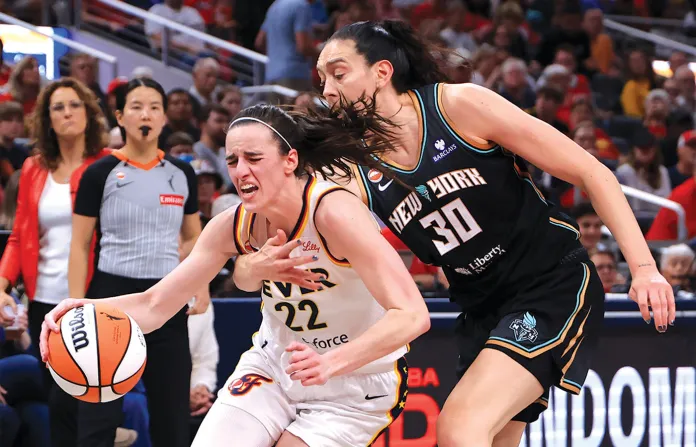
Nowhere has that mismanagement been more visible than in how the league has let Clark get hit on the court. In June, the Phoenix Mercury’s Alyssa Thomas drove a fist into Clark’s throat during a scramble for a loose ball. No foul was called in real time, and Clark left the game with a back injury. Sports Business Journal later reported that Engelbert initially had no plans to suspend Thomas until NBA commissioner Adam Silver personally intervened and pushed her to act. Thomas eventually received a retroactive flagrant foul and a one-game suspension. Silver wouldn’t confirm his role directly when asked about it publicly, but he didn’t deny it either, which is about as close to an admission as these things get. A group of Republican lawmakers went so far as to write Engelbert a letter demanding she ensure a “safe and professional environment” for the game’s biggest star.
Through it all, Clark’s fellow players seem ambivalent about her at best. It is hard to know whether they like her or resent her, and, depending on the player, both are likely true. What’s not in dispute is that the quality of play across the league has never been better, which makes the Clark drama all the more frustrating. It’s drowning out genuinely great stories such as the emergence of Minnesota Lynx guard Olivia Miles and Dallas Wings guard Paige Bueckers.
THE WNBA HAS A BLACK ENTITLEMENT PROBLEM
To be sure, Clark isn’t the best player in the WNBA. Bueckers and Las Vegas Aces center A’ja Wilson both have strong claims to that title. But she remains, without question, the league’s biggest phenomenon and its most reliable ratings draw, its own version of Steph Curry: never quite the consensus best player of his era, but for most of his career the most electrifying one to watch. And Clark keeps giving us reasons to believe that she could become the best player in the WNBA. On July 17 against Seattle, she scored a career-high 45 points with 10 assists, the first 40-point-or-more, 10-assist game in league history, while also becoming the fastest player ever to reach 200 career three-pointers.
So why does the WNBA keep getting this wrong? Personally, I don’t believe there’s any malice at work here. There’s no need to reach for specious conspiracy theories. The most probable explanation is that a league office built for decades to run a smaller, quieter operation got thrust into stadium-filling, headline-grabbing relevance almost overnight, and its business practices haven’t caught up to its newfound popularity. Picture that beloved neighborhood restaurant again, except now it’s gone viral: the tables are full, the phone won’t stop ringing, the lines are out the door, and the same skeleton crew that once handled a slow Tuesday night is trying to run service at five times the volume. That’s the WNBA right now — less a kitchen sabotaging its own star chef than one that has never had to manage a chef this famous.
Daniel Ross Goodman (@DanRossGoodman) is a Washington Examiner contributing writer and teaches theology and religious studies at St. John’s University. His next book, Dante’s Guide to Life: How The Divine Comedy Can Change Our Fortunes, Our World, and Ourselves, will be published this fall by Angelico Press.
