

Airport security is beginning to buckle under the strain of the nearly monthlong shutdown of the Department of Homeland Security — but neither Republicans nor Democrats appear under much pressure to end it.
Senators again failed Thursday to advance legislation to fully fund the DHS, marking the fourth time in recent weeks the chamber has rejected an attempt to break the impasse as lawmakers departed Washington for the weekend.
Transportation Security Administration officers say financial stress, staffing shortages, and rising callouts are beginning to affect screening operations at airports nationwide as thousands of workers continue to miss paychecks.
At several major airports, passengers faced lengthy waits to clear security, with lines stretching far beyond checkpoint areas. Travelers in cities including Atlanta, Houston, New Orleans, and Charlotte have reported waits exceeding an hour during busy travel periods, with some passengers missing their flights.
Since the partial government shutdown began Feb. 14, unscheduled absences among TSA have more than doubled nationwide, and more than 300 officers have left the agency, according to data provided to the Washington Examiner. Several days recorded notably higher nationwide absence rates. The peak reached 9% on Feb. 23, followed by 8% on March 6 and 7% on March 9.
About 60,000 TSA employees have spent nearly a month receiving reduced pay and are expected to receive their first $0 paycheck of the shutdown this week.
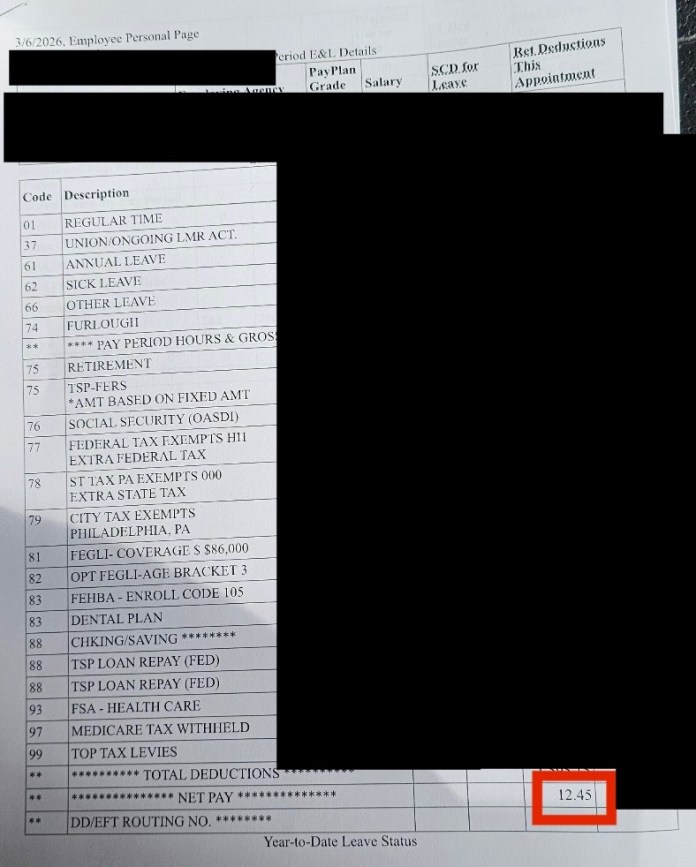
Joe Shuker, vice president of Region 7 for the TSA union’s bargaining unit, said some officers have already received paychecks so small that deductions wiped out nearly all of their earnings. He shared redacted pay stubs showing officers receiving only a few dollars after health insurance and retirement deductions were taken out.
“I have people who got paid $12, $7.50 last time,” Shuker said, speaking to the Washington Examiner. “Most people didn’t get $100 in the check.” The next paycheck, he added, will be worse. “This one will be zero.”
Shuker warned that the financial strain is beginning to raise broader concerns about airport security, given the level of focus required for the job.
“It’s a stressful enough job,” he said. “We’re looking for bombs or weapons. You’ve got to be sharp.” But when officers are worrying about basic expenses, their concentration can suffer. “If you’re worried about how you’re going to feed your kids tomorrow or how you’re going to get to work, you’re distracted. We don’t need any more distractions.”
Some officers are now taking on second jobs after their shifts to cover basic expenses, he said, a situation that can leave workers exhausted.
“You’re working full time, you’re on the X-ray, and then when you leave work you’ve got to go drive for Uber for a couple hours to get some money to feed your kids and put gas in your tank so you can get back to work,” Shuker said. “You have somebody tired and stressed out now they’re looking for bombs. It’s certainly a concern.”
Shuker said some TSA managers have tightened disciplinary policies during the shutdown, requiring officers who call out sick to provide medical documentation, a cost many workers can’t afford.
“They’re requiring anybody who calls out to bring in medical documentation,” he said. “That’s another $40 expense on somebody who doesn’t have money.”
In some cases, officers have even been asked to prove they cannot afford gas to commute.
“Imagine calling your boss and saying, look, I can’t pay for gas to come in,” he said.
Front-line TSA officers say the shutdown is forcing many workers to make difficult financial choices after draining savings during previous funding lapses. One TSA officer in North Carolina, speaking to the Washington Examiner on the condition of anonymity for fear of retaliation, said he used most of his financial reserves during the last shutdown and now has little left to fall back on.
“I have about $1,000 left in my bank account and I have to choose between taking a loan from my retirement or getting a personal loan,” the officer said, adding that he does not qualify for certain furlough loans offered through credit unions because he was not a member before the shutdown began. “This shutdown has absolutely nothing to do with TSA, the Coast Guard, FEMA, and we’re paying the price.”
Despite the strain, he said many officers continue reporting to work because they fear disciplinary action if they miss shifts.
“With this administration, many officers are afraid of calling out,” he said. “No one wants to lose their jobs. We just work harder.”
He added that staffing pressures have not yet halted operations at his airport.
“We have a great airport,” the officer said. “No matter how many callouts we have, we’re able to keep the lines moving.”
Another TSA officer in Dallas, speaking anonymously, warned the situation could escalate quickly if the shutdown drags on.
“If Congress doesn’t get DHS funded by March 28, they’re going on vacation until April 12,” the officer said. “That turns it into a minimum 60-day shutdown. That’s four missed paychecks.”
While attrition has remained within normal ranges so far, he said many workers are nearing the limits of their savings.
“I don’t know a lot of people that have a $10,000 emergency fund,” he said. “I do, but I’m an anomaly.”
The political standoff in Washington shows little sign of easing.
The Senate voted 51-46 on whether to move forward with the House-passed DHS funding bill, falling short of the 60 votes required to proceed. Senate Majority Leader John Thune (R-SD) cast a “no” vote for procedural reasons, preserving the option to bring the measure back up later.
Before the vote, Senate Republicans blocked Democratic attempts to pass narrower funding bills that would temporarily reopen parts of DHS, including the TSA, the Cybersecurity and Infrastructure Security Agency, the Coast Guard, and FEMA.
Democrats said the measures were intended to restore funding for key DHS operations caught in the shutdown and force Republicans to oppose reopening them. Republicans rejected the effort, and negotiations between senior congressional Democrats and the White House remain stalled.
The blame game has intensified on Capitol Hill.
“Why won’t they budge to give an inch on ICE, which is highly unpopular and even the president has said hasn’t done things right?” Senate Minority Leader Chuck Schumer (D-NY) said Thursday on the Senate floor.
Republicans pushed back.
Sen. Susan Collins (R-ME), the Senate’s top Republican appropriator, said Democrats’ approach to negotiations could be “characterized by a lack of urgency and a lack of seriousness.” She also accused Schumer of “sitting on what is a good faith offer from the White House” for weeks.

Airlines for America President and CEO Chris Sununu urged Congress to end the shutdown as travel demand remains high.
“More than 2.7 million people cleared through TSA yesterday, but too many had to wait in extraordinarily long—and painfully slow—lines at checkpoints,” Sununu said in a statement this week. “It’s unacceptable to have wait times of 2 or 3 hours. And it’s unacceptable that TSA officers will have $0 in their paychecks this week.”
Shuker said travelers caught in the disruption should understand that TSA officers are continuing to show up to work despite the financial strain.
“Our officers are going to come to work as long as they possibly can,” he said.
DENVER AIRPORT REQUESTS GIFT CARD DONATIONS FOR TSA EMPLOYEES AMID DHS SHUTDOWN
But he said the longer the shutdown drags on, the harder that becomes for many workers.
“At some point, everybody hits a breaking point,” Shuker said. “All we’re asking is that people remember the officers at the checkpoint didn’t cause this.”
